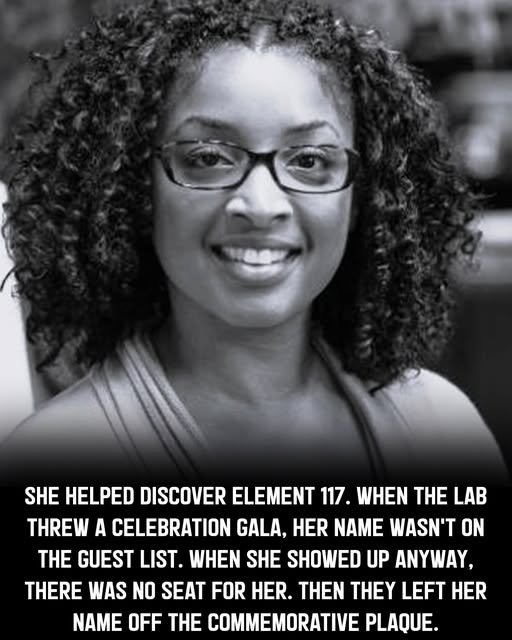
The Scientist Who Had to Fight for Her Seat at the Periodic Table
The inspiring life story of Clarice Phelps is one of triumph over systemic barriers, beginning in Nashville’s public housing projects and culminating in a seat at the Periodic Table. As the first African American woman to be involved in the discovery of a chemical element (Tennessine, Element 117), her meticulous work purifying the extremely rare berkelium-249 isotope at Oak Ridge National Laboratory was critical to one of the most significant scientific achievements of the 21st century. But her struggle didn’t end with the science; it began with the politics of recognition, exposing the often-unseen battle for inclusion in the world of STEM.
The Gala and the Grief: Omission After Achievement
The most devastating moment of her professional life came not from a failed experiment, but from institutional oversight. When Oak Ridge held a gala to celebrate the discovery of Tennessine, Clarice’s name was not on the guest list. After finally gaining entry, she was forced to stand and watch the celebration, realizing there was no place card for her. The exclusion continued with the commemorative plaque honoring all contributors—her name was initially absent. She described crying, realizing that even after achieving a monumental scientific feat, the message was clear: if you are a Black woman, you still might not be deemed worthy of a seat at the table, let alone recognition on a permanent monument.
Fighting for Her Name: Triumph Over Erasure
Clarice Phelps refused to be erased. She found the courage to fight for months, demanding that the plaque be recommissioned with her name included. This struggle, which the lab called an “inadvertent omission,” ultimately secured her rightful credit. Her story became a public rallying cry when her Wikipedia article was briefly deleted for “lack of notability.” Today, she uses her platform to address the isolating reality of being a Black woman in science, noting that only 2% of STEM workers are Black women (National Science Foundation). She advocates fiercely to ensure that the next generation does not face the same painful exclusions.
A Permanent Legacy: Element 117
Clarice Phelps’s true legacy isn’t the fight, but the element itself. Element 117—Tennessine—will exist forever on every Periodic Table in every classroom across the world. It is a constant, permanent monument to her skill, her perseverance, and her vital contribution to science. Her life proves that a determined spirit, rooted in a pawn shop microscope and fueled by a 2.98 GPA, can overcome systemic prejudice and achieve historic greatness, forever reminding every little girl looking at that chart: someone like me did that.
