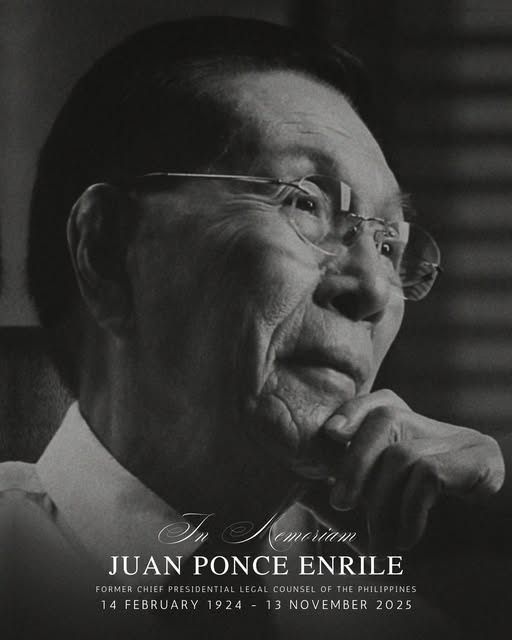
End of an Era: Juan Ponce Enrile Passes Away at 101
The Philippines bids farewell to one of its most prominent and polarizing political figures, Juan Ponce Enrile, who has reportedly passed away at the age of 101 due to complications from pneumonia. Known as the architect of Martial Law under former President Ferdinand Marcos and a pivotal player in the 1986 People Power Revolution, Enrile’s passing marks the end of an era in Philippine politics.
Born in 1924 in Cagayan, Enrile’s life spanned the country’s most turbulent and transformative decades. He held multiple government positions, including Defense Minister, Senate President, and Chief Legal Counsel, shaping the political landscape for more than half a century. Despite controversies surrounding his role during Martial Law, he remained a figure of influence and intellect until his final years.
According to sources close to the family, Enrile had been battling recurring pneumonia, a condition that ultimately took his life peacefully in his residence surrounded by loved ones. The news of his passing has sent shockwaves throughout the Philippines, with tributes pouring in from political allies, former colleagues, and even critics acknowledging his impact on the nation’s history.
A Life of Power, Controversy, and Unmatched Political Resilience
Few figures in Philippine history have been as complex as Juan Ponce Enrile. To some, he was a brilliant statesman, a man of law whose intellect and strategic mind helped guide the country through times of upheaval. To others, he was a symbol of authoritarian excess, associated with the abuses and human rights violations during the Martial Law era.
Yet, Enrile’s legacy cannot be defined by one chapter alone. His dramatic defection from Marcos during the 1986 EDSA Revolution became a catalyst that helped restore democracy. His later years saw him return to public office, serving as Senate President and adviser to key political figures, demonstrating an unyielding passion for governance even into his later years.
Throughout his century-long life, Enrile was often described as a “survivor”—outlasting political rivals, controversies, and even imprisonment. His ability to reinvent himself through changing political climates earned him both admiration and criticism, making him one of the most enduring personalities in Philippine politics.
Remembering a Titan of Philippine Politics
As the nation mourns his passing, many reflect on Juan Ponce Enrile’s towering influence on the course of Philippine history. His career was one of paradox—marked by triumph, turbulence, and transformation. Supporters hail him as a man of vision and intellect who helped shape the modern Philippine government. Detractors, however, remember the shadows of Martial Law and the painful memories tied to it.
Nevertheless, Enrile’s death invites reflection on a legacy that spanned dictatorship and democracy, loyalty and rebellion, controversy and courage. His story is inseparable from the nation’s own — a narrative of resilience, reinvention, and power.
Enrile leaves behind a family, a lifetime of public service, and a nation forever shaped by his choices. As the Philippines looks ahead, his name will remain etched in history books as one of the most influential, divisive, and unforgettable figures in the nation’s political landscape.